About Buoyant
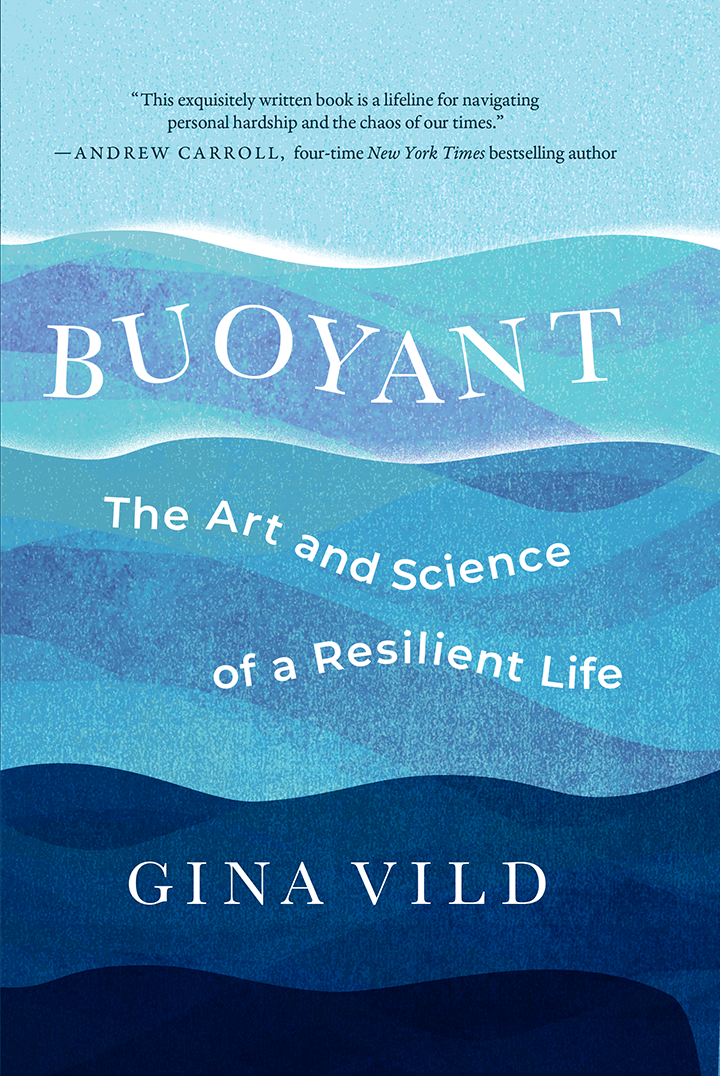
A science-backed and story-driven guide for staying afloat amid personal storms and the collective chaos of our world.
If you've been shattered by grief, weighed down by loss, or overwhelmed by life's challenges, both large and small, you're not alone. Adversity is a universal human experience, but your resilience--how you respond, adapt, and recover--shapes your outlook, strength, and well-being. What matters most isn't what happens to you, but how you rebound and chart a new path forward--your buoyancy.
Written with deep compassion and vivid storytelling, Buoyant is a science-backed, hope-filled road map for grief healing, trauma recovery, and post-traumatic growth. Author Gina Vild draws on psychology, neuroscience, timeless wisdom, poetry, and her experience to show that resilience isn't something you're born with--it's a skill you can cultivate and strengthen at any age.
This book offers both inspiration and action: inspiration in the form of twenty-plus stirring stories of transformation from people who faced both unimaginable challenges and everyday struggles, and actionable steps in the form of "Buoyancy Boosters"--interactive exercises and practical coping strategies to build resilience. Put together, Buoyant is a toolkit to reframe pain, manage negative self-talk, practice mindfulness and acceptance, embrace forgiveness, rediscover your sense of purpose, and build a supportive community.
Whether you're healing after personal loss, navigating trauma recovery, overcoming professional setbacks, or simply trying to stay afloat in a chaotic world, Buoyant is your essential guide. It proves that profound healing is possible, resilience can be learned, and a life of joy and meaning is always within reach.
Buoyant Stories
Excerpts from the book
-
Preface:
I don’t recall who chose to watch a film about the Enigma code that particular Saturday night. Was it my husband or me?
Ironic, I thought much later. The Imitation Game, a film about the British cracking the German code that masked so many powerful secrets and ultimately led to the liberation of Europe, was a metaphor for the revelations about to unfold in my life.
My husband sat at a distance, engrossed in the film, while I perched on the sofa, ignoring it. My eyes were focused on a pile of unopened envelopes that held eight years of bank statements.
I discovered the paper trail when I uncovered a private account on my husband’s computer. The account was buried beneath a layer of security that erased daily searches and routinely changed passwords. I was an inexperienced sleuth, but once I learned of the bank account, I surreptitiously ordered every obtainable statement. I feared they would open Pandora’s box, and I would learn things from which there would be no return.
For days, the envelopes remained unopened, taunting me.
I recall the moment my hand reached for the top statement but recoiled. I thought: Destroy them. Toss them unopened into the fireplace that is providing the only warmth in the room this evening. Preserve your perfect life and your idyllic twenty-eight-year marriage, let those envelopes keep their secrets. Save yourself from what is likely to spill forth and char your most treasured memories.
Over the previous six weeks, something long dormant stirred and then emerged as a formidable force that demanded I take a closer look at my life. It prodded me to begin pulling at threads. Each thread I tugged revealed something incongruous with the life I thought I was living. Each thread exposed events that teased me with the knowledge that things were far different from what I believed about my husband and our long, happy marriage. The more I unraveled, the more I yearned to see it all. How could I get a clear bird’s-eye view of my life?
The answer came as I recalled a friend’s offhand comment from long ago: “When you want to know the truth about anything, follow the money.” Her voice led me to the bank account and, ultimately, to the bank statements.
I was at an inflection point from which there would be no return. My chest literally hurt. My breathing shallowed.
My intuition did not fail me. What I learned that night changed everything. Opening those envelopes obliterated thirty years of certainty. I remember thinking that my marriage was a precious crystal, and that night it shattered. So much of what I thought to be true turned out to be a myth, outwardly beautiful, but nonetheless a myth. Ultimately, the envelopes led me to a well-concealed parallel life, one woven into our story from its earliest days. They shattered the storybook illusion that held my family together.
That night I pulled back the curtain, and, like the revered Wizard of Oz, my husband turned out to be someone far different from his public persona. He was a man I no longer recognized.
Only in time would I come to see that this rupture had its genesis in lives lived long before we even met, in fault lines formed well before I entered his story, and in my own complicity: moving through the world in a way I had learned young, with an unguarded, self-assured tendency to trust what was offered, to mistake what was visible for the whole. But this reckoning of my marriage would come much later.
That evening I wasn’t thinking about the undercurrents, only the consequences. What would I, what could I, do with the information as it spilled forth? Could I walk away from the three-decade relationship at the core of my life, a source of strength and, as I long thought, love? How would this affect my two young adult children whose happiness meant everything to me? Could I dismantle a life that had given them, and me, solace and joy for decades?
There’s no question it might have been easier to stay in my marriage. But given what I’d learned, I didn’t hesitate a moment before deciding to end it on April 26, 2015. In a single instant, I confronted an avalanche of questions about my own life and about the marriage I long treasured.
That night, despite all the questions that spilled forth, there was one thing about which I had absolute, unshakable clarity: I deserved better.
The first two envelopes dealt a fatal blow to my long marriage. In the wee hours, at 2:00 a.m., I asked my husband to leave. I made a life-shattering decision to let go of someone I loved and the one person who shared my most intimate memories. In making that decision, I knew I had opened myself to emotional and financial vulnerability. I was terrified but undeterred as I opted to free-fall without a net, giving up what most people strive for: companionship, security, and love. That evening set me on a course in which I had to rebuild my entire life, one that is today unrecognizable from the one I had been living.
This wasn’t my first crucible.
-
The Death of Our Two Daughters Gave Us New Purpose
“We can’t change our past, but we can change someone else’s future.”
Two of Jamie and Kathy’s young daughters battled aggressive cancers. One died before they knew the truth, before they learned that Jamie carries a genetic mutation that left all three of them vulnerable to a wide range of cancers.
“For years we had been told by doctors we were just an ‘unlucky cancer family,’” Jamie recalls. His father died of a brain tumor at thirty-seven. His sister had three cancers in her twenties. Then their daughters got sick. First, twelve-year-old Kerry was diagnosed with osteosarcoma and endured brutal chemotherapy and limb reconstruction.
Seven years later, their seventeen-year-old daughter, Maureen, left for college healthy and happy, only to return home weeks later with a devastating diagnosis: adrenal cortical carcinoma, stage IV. “Our beautiful daughter died five months later,” Kathy says.
It was only after Maureen’s death that a doctor wisely suggested the family might have a hereditary cancer syndrome caused by a mutation of the TP53 gene, a critical cancer-fighting gene. Testing confirmed Kerry indeed had Li–Fraumeni Syndrome, known as LFS, making her susceptible to a wide range of cancers. Later testing confirmed Jamie, too, had inherited it.
Kerry, always determined, refused to take any chances. She took every precaution. When doctors found precancerous cells in her breast, she had a preventive double mastectomy. Kerry lived to experience the great joy of marrying and giving birth to two daughters. Due to remarkable scientific advances, the girls were born through in vitro fertilization and a process called PGD, pregenetic diagnostic testing, that ensures the embryos implanted are mutation-free. For a while, they thought Kerry had outrun her fate.
But when pregnant with her second daughter, Kerry felt a lump in her breast. Her doctors said it couldn’t be cancer because she had no breast tissue left. “But it was,” Kathy says. “By the time they took it seriously, it had spread everywhere.”
Kerry died in 2014, leaving behind two small children who are the light of Jamie and Kathy’s lives.
Months after Kerry’s death, Jamie felt a lump under his arm. A local doctor misdiagnosed it as a cyst. He soon learned that he had a soft tissue sarcoma for which he was successfully treated.
This was a family grappling with cancer. It had robbed them of two of their daughters, and it now threatened Jamie. Jamie and Kathy, deeply grieving, decided to turn their fate into purpose.
“People always ask how we survived all this,” Kathy says. “The truth? We had no choice. But we both knew we didn’t want other families to experience such devastating loss.”
For years after learning about LFS, they were utterly alone.
“We had never met another family with LFS. We had no community to turn to for guidance. That’s why she and Jamie flew to Ohio when Kathy found a Li–Fraumeni Syndrome Association, or LFSA, conference in 2016.
“We sat in a room with people who actually understood, who had the same fears, the same impossible choices. At the time, I wasn’t comfortable with public speaking, but I was inspired,” Kathy recalls. “I stood up and said, ‘I want to help. Give me something to do.’”
Since then, Jamie and Kathy have dedicated themselves to ensuring the public knows about inherited cancers, LFS, and the lifesaving impact early diagnosis can have in treating and curing cancer. They want to make sure other families never have to navigate LFS alone.
Kathy today is on the board of LFSA and deeply involved in advocacy and education, connecting newly diagnosed families with specialists, educating doctors, and pushing for better screening protocols. “So many people don’t know about LFS,” she says. “We are changing that.”
Jamie is also active in spreading the word. “I do my part, too. I talk to people one-on-one, share our story, and make sure they get the right care. I’m more of a day-of volunteer,” he jokes. “But I show up.”
They remind families: Knowledge is power. If you don’t know, you can’t protect yourself. They advocate for genetic testing to enable early diagnosis and ensure those with LFS understand that radiation therapy may not always be the best treatment option.
The mission: Knowing if you have LFS is just the first battle. The second? Making sure doctors take you seriously, and you get the surveillance and treatments you need.
In addition to Jamie’s early misdiagnosis, there was more. “I was being treated for prostate cancer when a urologist brushed me off and said, ‘What do you want me to do, operate? You want to walk around in diapers for the next twelve years?’” Jamie recalls. “I told him I had LFS, but it didn’t make a difference. I immediately saw another doctor who understood my risk.”
“If you don’t open your mouth, if you don’t do your own research, you won’t get what you need,” Jamie says. “Just because someone has an MD after their name doesn’t mean they know what’s best for you.”
Kathy, in her advocacy work around the country, sees this all the time: patients dismissed, misdiagnosed, or given outdated advice. That’s why she connects families to LFS experts who understand proactive screening and the importance of early detection. “We don’t want others to hear ‘it’s just bad luck’ and believe it,” she says. “We want them to get the right care before it’s too late.”
When they reflect on their own resilience in the face of overwhelming loss, Kathy describes it as a force that pushes you through life’s challenges, no matter how daunting they may be.
For Jamie, he says, “I’m resilient because, quite simply, I have no other choice. Giving up is not an option.”
-
The Greatest Comeback off the Court
“As an athlete, I learned structure. In recovery, I use that same mindset. This is what gave me seventeen years of sobriety.”
It was a moment of reckoning: step toward healing or fall back into the abyss of darkness.
Chris Herren had overdosed a third time. He lay in a treatment center, thinking his life was over. “We were on food stamps, had no electricity, and, at times, no heat. We had two young children and a third on the way.”
This time, a counselor looked him in the eye and said, “You’re a has-been. A junkie. You don’t have any business being a father. Have your wife tell your kids their dad died in a car accident because they do not deserve you.”
Those words broke something open. That night, Chris fell to his knees and prayed. “My mom, who died young, was spiritual. So was I. I had nowhere else to turn. For five years, I went to bed contemplating an exit. That night, I chose life.”
But sobriety wouldn’t be easy. It would be a long, bumpy path requiring daily vigilance.
Chris grew up in Fall River, Massachusetts, in a loving family that grappled with generational addiction. Both sides struggled with alcoholism. His young parents worked hard to give their children a better life, eventually moving them out of subsidized housing.
For all the instability of his youth, Chris discovered he had a gift: basketball. His talent was undeniable. He was hailed as one of the top players in the country.
While fans watched his highlight reels in awe, Chris was unraveling. At Boston College, he was introduced to cocaine. “It changed everything,” he recalls. “I fell in love with the effect. Cocaine allowed me to be honest about my emotions. For the first time, I could tell the story of my struggle and pain.”
At twenty-three, Chris was drafted into the NBA by the Denver Nuggets. “It should have been the best day of my life,” he says. “But I knew it wouldn’t last. I wasn’t ready. I had been battling addiction since I was eighteen. I knew it would win.”
Within months, he was introduced to OxyContin. At his worst, he was taking sixteen hundred milligrams a day and spending $20,000 a month.
Chris went on to play for the dream team of his childhood, the Boston Celtics, and then for professional teams overseas. As his career progressed, so did his addiction. “I transitioned from pills to heroin. I used everywhere.”
His first overdose came when he was twenty-five, in a parking lot. The car was in gear and rolled into another car, alerting EMTs. Had it been in park, he would have died. “That accident saved my life and shattered everything. I had just finished playing with the Celtics. Now I was on the news as a heroin addict. It was devastating for me and my family.”
He tried recovery several times. “Each time, I thought I could spend five days and walk out. I saw it as punishment, not healing.”
At thirty-two, Chris entered inpatient treatment again. This time, Chris committed to treatment for eleven months. “I was terrified to go home,” he says. “I saw the hope in my family’s eyes. I didn’t want to break their hearts again.
“I was broken. I felt deep shame. I had no money, no education, no career. Every night for six months, I thought about running. But I didn’t. That drive to persist gave me the life I have today.”
Even after seventeen years of sobriety, he says the work isn’t over. “The real work began when I started to revisit the trauma and pain.”
A year into Chris’s recovery, serendipity led him to his purpose. “A private school principal handed me keys to a gym and told me to teach kids how to play ball.”
That moment inspired Hoop Dreams, a basketball training and mentoring program. Soon after, a health teacher invited him to speak at a local high school. “She picked me up and said she’d pay me in Dunkin’ Donuts. That was the start of my speaking career. Since then, I have spoken to a couple million kids through Herren Talks.”
At first, he talked about his worst day. But that changed. “I began talking about the first day. We always show kids how addiction ends. But we don’t ask why it begins. We don’t ask the single most important question: Why?”
Chris founded the Herren Project in 2011, a nonprofit that’s helped over five thousand people access treatment, and Herren Wellness in 2018, a recovery center built on holistic healing, from breath work to eye movement desensitization and reprocessing (EMDR). His life’s work is to use his pain to help others find recovery and restore hope to the families who love them.
But even long-term sobriety isn’t a straight line. “Years fourteen to sixteen were the hardest. I had a hip replacement. I lost people I loved. My dad got dementia. I didn’t want to be me.”
Then a therapist walked into his center. “We started talking. I had never done therapy. He introduced me to Internal Family Systems. I met my inner child. My inner adult. They both needed healing.”
Chris credits his resilience to his sports mindset. “As a pro athlete, I knew structure. Recovery is the same. It’s commitment, repetition, mindset.”
Today, when asked what he’s most proud of, Chris doesn’t hesitate. “My sobriety made my children smile again. The smile isn’t just on their faces. I see it in their eyes. That’s everything.”
-
Defying Every Odd
“They told me I would never survive. They told me I would never have children. They were wrong.”
Jennifer Bourne was a high school senior and library aide, known for being a goody-two-shoes, when she was diagnosed with stage III Hodgkin’s lymphoma. Her doctors offered a grim prognosis: She had one year to live.
To stave off an aggressive disease, her medical team threw the full weight of the most brutal treatments at her. She endured harsh chemotherapy that ravaged her young body, a splenectomy that left her vulnerable to a host of life-threatening bacterial infections, and brutal radiation that left permanent scars, reshaping her body.
Their best hope was to buy her a bit more time. But survival? Her doctors told the family that was unlikely.
Jennifer faced multiple painful procedures and long periods of isolation. Every time her body wanted to give up, she pushed forward, refusing to accept that her time was running out.
Against all odds and astonishing her physicians, Jennifer survived. Her recovery defied every medical expectation and upended what was commonly reported in established medical journals.
For three years, Jennifer lived in remission and thrived. She reached for love and found it, marrying her high school sweetheart at age twenty.
At twenty-one, Jennifer received news as shocking as her initial diagnosis: she was pregnant.
Doctors told her she would never carry a child. The damage from years of harsh treatment was too great, the odds impossible. But now, she was going to be a mother.
Upon hearing the news, her oncologist didn’t join her in celebrating. He responded, “You’re not keeping it, right?” reeling off worst-case scenarios: her child could be born without a brainstem, without functioning organs, without a chance.
Importantly, he told Jennifer that if she carried to term, the child would likely grow up without a mother, given the severity of her disease.
Jennifer refused to believe it, and subsequent testing confirmed her instincts.
“For the first time in my life, I had something truly good happening,” she recalled. “And I wasn’t about to let it go. This was my miracle.”
Jennifer’s beautiful daughter Emilie was born in perfect health.
But her cancer refused to be ignored. When her precious daughter was only one month old, Jennifer’s lymphoma returned with a vengeance, now stage IV.
There were two options: undergo a bone marrow transplant, which had dismal survival at the time, or undergo another aggressive round of chemotherapy.
Jennifer chose chemotherapy. Why? “I needed to hold my baby,” she said.
And, again, against all odds, the treatment worked.
While cancer was proving a formidable enemy, this wasn’t Jennifer’s first battle. Long before cancer, Jennifer had endured severe abuse from ages six to sixteen. That trauma tested her, shaping her understanding of survival long before she faced a medical crisis.
“I think my resilience came from being a survivor of that,” she admitted. “I was on my own. I knew no one was going to save me but me.” It was a lesson she carried into every challenge. “It also made me an empath and allowed me to love life and to love others more than myself.”
Jennifer never let that early pain define her, just as she was defiant in never letting cancer define her.
The years passed. Jennifer raised her daughter, found joy in everyday moments, and cherished her friendships. Her family jokingly called her “Jenny Lewis” because she loved to laugh.
But cancer was dogged. It knocked on her door over and over, six times in all. She endured treatments for Hodgkin’s disease, thyroid cancer, uterine cancer, and lung cancer. She had open-heart surgery. And throughout, she grappled with the long-term effects of the radiation that had long ago saved her life.
Each time, she fought. Each time, she won.
“They told me I would never survive,” she said. “They told me I would never have children. They were wrong.”
Through it all, Jennifer remained ebullient, embracing life, animals, and people. She could cement a friendship within minutes and paid forward the gift of an extended life with boundless generosity.
She worked in law firms and as a teacher’s assistant, where she was known for the joy and tenderness she brought to the students. She volunteered for cancer support groups, offering guidance to those just beginning their fight. To fellow survivors, she reminded them that their scars need not define them, that strength could be found even in pain.
Jennifer defined her superpower, and the legacy of her cancer experience and abuse, simply: “I feel more than the average person. I feel pain more, but I also feel joy more. I feel sadness more, but I also feel happiness more.”
Jennifer’s life was never about surviving. It was about living. And for every single day beyond that one-year prognosis, she did exactly that. She created a family no one could imagine in 1989, marrying a second time, raising two more daughters and a son, and welcoming two grandchildren, each new life a testament to the fight she refused to lose.
Jennifer died in the spring of 2024 at age fifty-six. She was interviewed for this book three years before her death. She left behind a life rich in love and a testament to the power of a spirit that refused to be broken.
About The Two Most Important Days
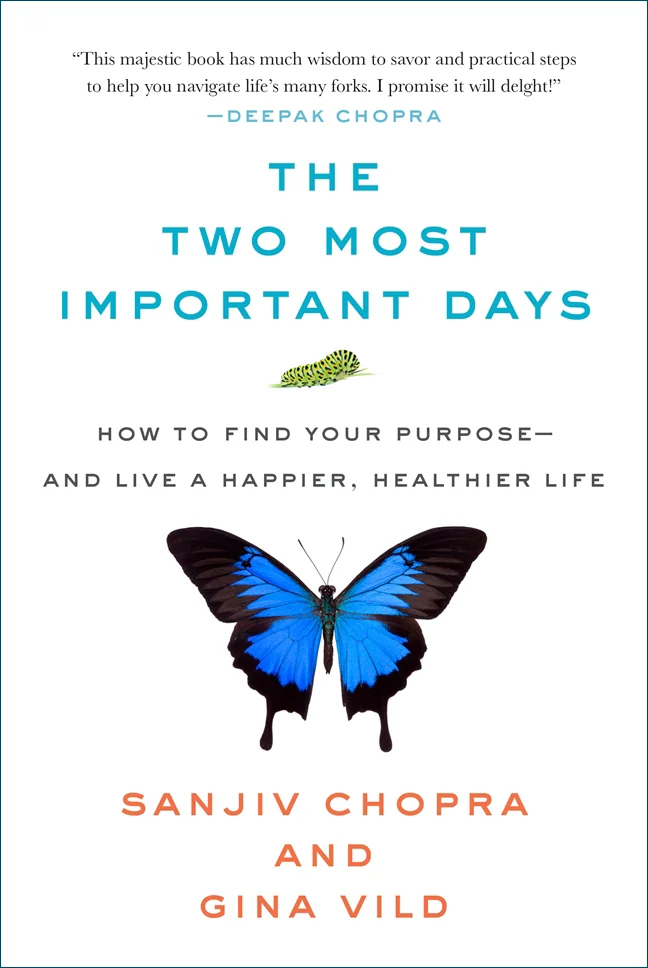
What are the two most important days in your life? "The day you are born and the day you find out why," Mark Twain famously wrote.
The search for happiness is hardwired in our DNA. It transcends age, gender, geography, vocation, and personal circumstances. But how do you achieve it?
Through inspirational storytelling, scientific evidence, practical advice, captivating exercises, and poetry, Dr. Sanjiv Chopra and Gina Vild present a powerful message that shows you how to achieve happiness no matter the challenges and stumbling blocks you face along the way. They also reveal the best way to be happy: Discover and live your life’s purpose. It’s a sure path to human flourishing. In fact, you may be surprised to learn that living with purpose can even add years to your life.
Do you know your life’s purpose? This book offers a path to discovering it by illuminating the value of gratitude, forgiveness, meditation, music, friendship and so much more. It will set you on the right path and spark sustained happiness, joy and bliss.